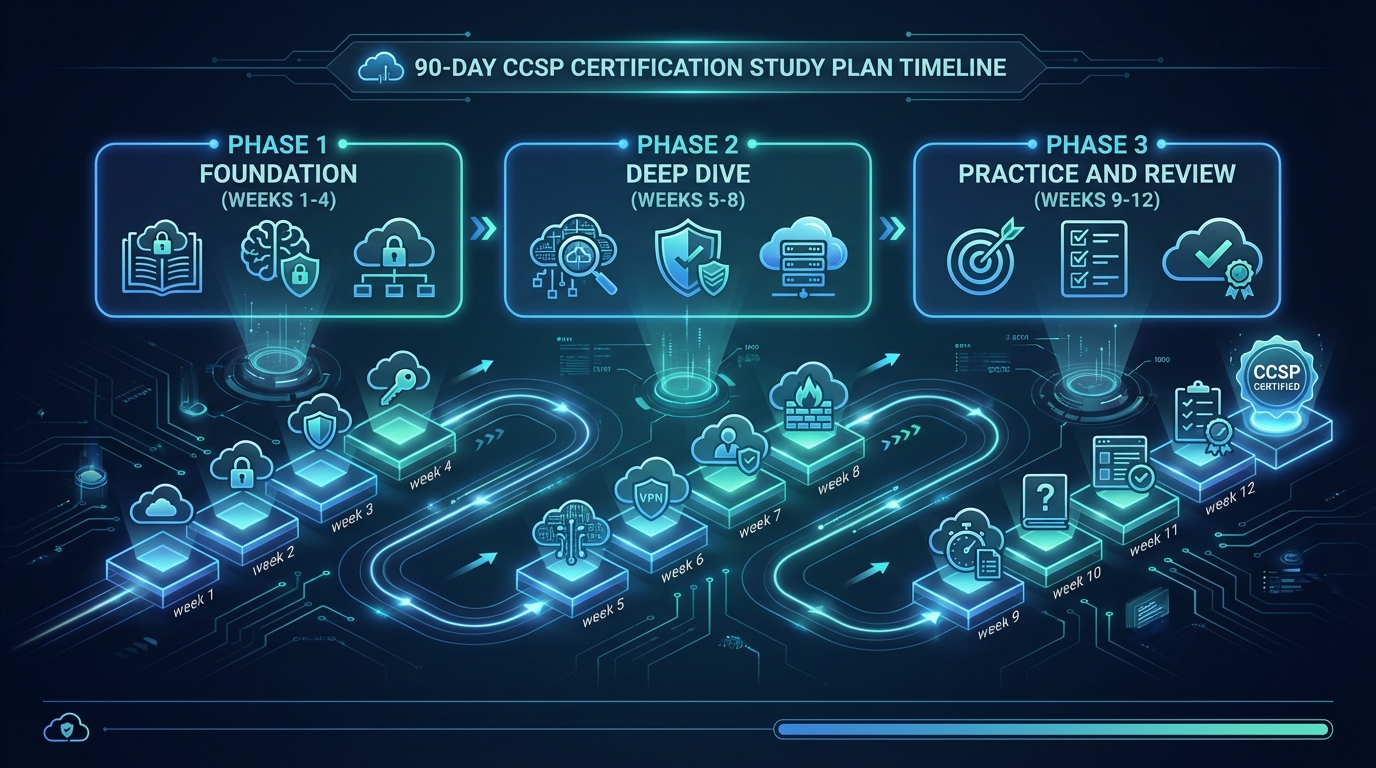
The Certified Cloud Security Professional (CCSP) certification from ISC2 is one of the most respected credentials in cloud security. It proves you can design, manage, and secure cloud environments at an enterprise level — and employers know it.
But passing the CCSP exam requires a structured approach. The exam covers six domains, uses a Computerized Adaptive Testing (CAT) format, and tests scenario-based thinking rather than rote memorization. A 90-day CCSP study plan gives you enough time to learn, practice, and review without burning out.
This guide gives you a complete week-by-week study plan, the best resources for 2026, domain-specific strategies, and exam day tips — everything you need to pass the CCSP on your first attempt.
📋 In This Guide
- CCSP Exam Overview (2026)
- Before You Start: Prerequisites & Assessment
- Best CCSP Study Resources
- Phase 1: Foundation (Weeks 1–4)
- Phase 2: Deep Dive (Weeks 5–9)
- Phase 3: Practice & Review (Weeks 10–13)
- Domain-by-Domain Strategy
- Study Tips That Actually Work
- Exam Day Game Plan
- Frequently Asked Questions
CCSP Exam Overview (2026)
Before diving into your CCSP study plan, understand what you're up against. The CCSP exam tests your ability to think like a cloud security architect and manager — not just recall definitions.
CCSP Exam at a Glance
- Format Computerized Adaptive Testing (CAT)
- Questions 100–150 multiple choice
- Duration 3 hours
- Passing Score 700 out of 1,000
- Cost $599 USD
- Testing Center Pearson VUE
- Experience Required 5 years in IT (3 in security, 1 in cloud)
The CAT format means the exam adapts to your ability level. Answer correctly and you'll get harder questions. Answer incorrectly and the difficulty drops. This means everyone's exam is slightly different, and the number of questions you see (between 100 and 150) depends on how quickly the algorithm determines your proficiency.
The exam covers six domains, each weighted differently:
CCSP Domain Weights
- Domain 1: Cloud Concepts, Architecture & Design 17%
- Domain 2: Cloud Data Security 20%
- Domain 3: Cloud Platform & Infrastructure Security 17%
- Domain 4: Cloud Application Security 17%
- Domain 5: Cloud Security Operations 16%
- Domain 6: Legal, Risk & Compliance 13%
Domain 2 (Cloud Data Security) carries the most weight at 20% — your study plan should reflect that. Domain 6 (Legal, Risk & Compliance) has the lowest weight but is often the most unfamiliar territory for technical professionals.
Before You Start: Prerequisites & Self-Assessment
The CCSP requires five years of cumulative paid work experience in IT, with at least three years in information security and one year in one or more of the six CCSP domains. However, you can take the exam before meeting the experience requirement and become an Associate of ISC2 while you build your qualifying experience.
Assess Your Starting Point
Your 90-day timeline assumes 1–2 hours of study per day (7–14 hours per week). Adjust based on where you're starting from:
- Cloud security professional (3+ years): You may be able to compress this plan to 60 days. Focus on domains where you lack hands-on experience.
- General IT security background: The 90-day plan fits well. Pay extra attention to cloud-specific concepts in Domains 1–4.
- New to cloud security: Consider extending to 120 days. Spend extra time on foundational cloud concepts before diving into security specifics.
- CISSP holder: 6–8 weeks is realistic. Focus on cloud-specific material and skip overlapping security fundamentals.
Best CCSP Study Resources (2026)
Don't overload yourself with 10 resources. Pick a primary text, a practice question source, and one supplementary resource. Here's what works best:
Primary Study Material (Pick One)
📚 Recommended Books
- Best Overall CCSP Official Study Guide (OSG) by Mike Chapple & David Seidl — The definitive resource, aligned directly with ISC2's exam outline. Dense but thorough.
- Best for Accessibility CCSP For Dummies by Arthur J. Deane — Clearer explanations for complex topics. Great companion to the OSG when concepts don't click.
- Best All-in-One CCSP All-in-One Exam Guide (3rd Edition) by Daniel Carter — Practical approach with exam tips and real-world examples integrated throughout.
Practice Questions (Essential)
- CCSP Official Practice Tests — From ISC2/Wiley. Closest match to actual exam question style.
- LearnZapp / Pocket Prep — Mobile-friendly practice question apps. Great for studying on the go.
- CISSP.app Practice Platform — AI-powered gap analysis that identifies exactly where you need to focus. Covers CCSP alongside CISSP preparation.
Supplementary Resources
- ISC2 CCSP Self-Paced Course — Video-based training aligned to the exam outline. Good for visual learners.
- Cloud Security Alliance (CSA) Guidance — Free reference material. The CCSP exam frequently references CSA frameworks.
- ISC2 CCSP Exam Outline — Free download from ISC2. Use this as your master checklist to ensure you've covered every objective.
- r/CCSP on Reddit — Active community sharing study tips, recent exam experiences, and resource recommendations.
Phase 1: Foundation (Weeks 1–4)
🟢 Goal: Build a solid understanding of all six domains
During the first four weeks, read through your primary study guide cover to cover. Don't try to memorize everything — focus on understanding concepts and building a mental framework for how the six domains connect.
Domain 1: Cloud Concepts, Architecture & Design (17%)
- Cloud computing definitions: IaaS, PaaS, SaaS, and deployment models
- Cloud reference architecture and design principles
- Key concepts: multi-tenancy, shared responsibility model, cloud service brokers
- Understand the role of the Cloud Security Alliance (CSA) STAR program
Domain 2: Cloud Data Security (20%)
- Data lifecycle: create, store, use, share, archive, destroy
- Data classification and discovery in cloud environments
- Encryption: at rest, in transit, in use — key management strategies
- Data loss prevention (DLP), rights management, data masking
- Spend extra time here — this is the highest-weighted domain
Domain 3: Cloud Platform & Infrastructure Security (17%)
- Physical and virtual infrastructure components
- Network security in cloud: VPCs, security groups, micro-segmentation
- Disaster recovery, business continuity planning in the cloud
- Virtualization risks: VM escape, hypervisor vulnerabilities
Domains 4, 5 & 6: Application Security, Operations, Legal
- Domain 4 (17%): Secure SDLC, application security testing (SAST/DAST), API security, identity federation
- Domain 5 (16%): Logging, monitoring, incident management, digital forensics in the cloud
- Domain 6 (13%): Privacy regulations (GDPR, CCPA), audit frameworks, compliance, contracts
- Take 25 practice questions at week's end to baseline your knowledge
Phase 2: Deep Dive (Weeks 5–9)
🔵 Goal: Master the details and connect concepts across domains
Phase 2 is where you shift from understanding to mastery. Go back through each domain, this time focusing on the specific details, acronyms, frameworks, and standards the exam loves to test.
Domains 1 & 2: Deep Review
- Map out the full domain structure with sub-topics — use the ISC2 exam outline as your checklist
- Study CSA Cloud Controls Matrix (CCM) and STAR certification levels
- Deep dive into encryption standards: AES-256, RSA, TLS 1.3, FIPS 140-2/3
- Understand key management: BYOK, HYOK, HSM, key escrow
- Practice 50 questions per domain. Review every wrong answer in detail.
Domains 3 & 4: Deep Review
- Network security deep dive: SDN, CASB, SASE, Zero Trust architecture
- Disaster recovery: RPO, RTO, MTPD, and cloud-specific DR strategies
- Application security: OWASP Top 10, SAMM, secure DevOps practices
- Identity management: SAML, OAuth 2.0, OpenID Connect, federation
- Practice 50 questions per domain. Track your weak areas.
Domains 5 & 6: Deep Review + Cross-Domain Connections
- Incident response in cloud: chain of custody, forensic imaging challenges
- SOC reports (SOC 1, SOC 2, SOC 3), ISO 27001/27017/27018
- Legal: data sovereignty, jurisdiction, e-discovery, privacy impact assessments
- Map connections between domains — exam questions often span multiple domains
- Take a full-length practice exam (150 questions). Score and analyze results.
Phase 3: Practice & Review (Weeks 10–13)
🟡 Goal: Simulate exam conditions and close knowledge gaps
The final phase is all about practice exams, targeted review, and building exam-day confidence. By now you should have a solid grasp of all six domains — this phase sharpens your test-taking ability.
Full Practice Exams
- Take 2 full-length practice exams (timed, 3 hours each)
- Target: scoring 75% or above consistently
- Review every wrong answer. Create flashcards for recurring weak spots.
- Focus on understanding why wrong answers are wrong — not just the right answer
Targeted Gap Remediation
- Analyze your practice exam results — which domains consistently drop below 70%?
- Re-read those chapters in your study guide
- Do 30–50 domain-specific practice questions for each weak area
- Review acronyms and standards: FIPS, ISO, SOC, CSA, NIST, ENISA
Scenario-Based Practice
- Focus on scenario-based questions — these are the majority of the real exam
- Practice the "think like a manager" mindset: best action, not just technically correct
- Take one more full practice exam. Target: 80%+ on all domains.
- Review the ISC2 exam outline one final time — any gaps?
Final Review & Exam Prep
- Light review only — no heavy studying. Trust your preparation.
- Review your summary notes and flashcards
- Schedule your Pearson VUE exam if you haven't already
- Get good sleep, eat well, and stay calm. You've put in the work.
Domain-by-Domain Strategy
Each CCSP domain has its own personality. Here's how to approach them strategically:
Domain 1 (17%)
Cloud Concepts
- Foundational domain — sets the stage for everything else
- Focus on service models, deployment models, and shared responsibility
- Know the CSA reference architecture cold
Domain 2 (20%)
Data Security
- Highest-weighted domain — allocate proportional study time
- Master the data lifecycle and security controls at each stage
- Encryption and key management are heavily tested
Domain 3 (17%)
Infrastructure
- Most technical domain — draws on real-world infrastructure knowledge
- Understand virtualization, SDN, and cloud networking
- DR/BCP concepts appear frequently
Domain 4 (17%)
App Security
- SDLC and DevSecOps are hot topics
- Know the OWASP Top 10 and how it applies to cloud apps
- Identity federation protocols are commonly tested
Domain 5 (16%)
Operations
- Incident response and forensics in cloud are unique challenges
- Understand logging, SIEM, and monitoring strategies
- Change management and configuration management processes
Domain 6 (13%)
Legal & Compliance
- Lowest weight but often the hardest for technical professionals
- Know GDPR, CCPA, data sovereignty, and cross-border transfer mechanisms
- Audit standards: SOC 1/2/3, ISO 27001, CSA STAR
Study Tips That Actually Work
1. Study Consistently, Not Intensely
One to two hours daily beats eight-hour weekend sessions. Consistent study builds stronger neural pathways for recall. Set a fixed study time each day and protect it.
2. Use Active Recall and Spaced Repetition
Don't just re-read chapters. After studying a section, close the book and try to recall the key points from memory. Use flashcard apps (Anki is excellent for spaced repetition) to revisit concepts at increasing intervals.
3. Explain Concepts Out Loud
The "teach it" method is one of the most effective learning techniques. If you can explain the shared responsibility model or the data lifecycle to someone with zero background, you genuinely understand it.
4. Think Like a Cloud Security Manager
ISC2 exams reward managerial thinking. When you see a scenario question, ask yourself: "What is the best action for the organization?" — not just the technically correct one. Sometimes the right answer is "assess the risk" rather than "implement the control."
5. Don't Skip Practice Questions
Aim for at least 1,000 practice questions over your 90-day plan. Review every wrong answer thoroughly. Track your performance by domain to identify patterns — if you consistently score low on Domain 2, that's where your next study session should focus.
6. Join a Study Community
The r/CCSP subreddit and ISC2 Community forums are full of candidates sharing tips and recent exam experiences. Reading "I just passed" posts is both informative and motivating. Just don't let community browsing replace actual studying.
Exam Day Game Plan
The Week Before
- Confirm your Pearson VUE appointment and check the test center location
- Review your summary notes — no new material this week
- Get 7–8 hours of sleep each night. Seriously.
Day Of
- Arrive 30 minutes early. Bring two forms of valid ID.
- Read each question twice. The CCSP loves nuance — one word can change the correct answer.
- Manage your time: 3 hours for 100–150 questions means roughly 1.2–1.8 minutes per question.
- If a question seems impossible, eliminate obviously wrong answers first. Then think: "What would a cloud security manager do?"
- Don't panic if questions feel hard. The CAT format means harder questions often mean you're performing well.
- You can't go back to previous questions in a CAT exam. Commit to your answer and move on.
Frequently Asked Questions
Is 90 days enough to study for the CCSP?
For most candidates with some IT security background, 90 days (12–13 weeks) at 1–2 hours per day is sufficient. Experienced cloud security professionals may need only 60 days. Those completely new to cloud security should consider 120 days. The key factor is consistent daily study, not total hours.
How does the CCSP compare to the CISSP?
The CCSP focuses specifically on cloud security across six domains, while the CISSP covers broader information security across eight domains. If you're deciding which to pursue first, consider your career direction — cloud-focused roles favor the CCSP, while general security leadership roles favor the CISSP. Many professionals eventually earn both.
What's the best order to study the six domains?
Start with Domain 1 (Cloud Concepts) since it provides the foundation for everything else. Then tackle Domain 2 (Data Security) while concepts are fresh — it's the highest-weighted domain. After that, Domains 3–6 can be studied in order. See our complete guide to all six CCSP domains for a detailed breakdown.
Can I study for the CCSP while working full-time?
Absolutely — most CCSP candidates study while working. The 90-day plan in this guide assumes 1–2 hours per day, which is manageable before or after work. Weekend sessions can be longer (2–3 hours) to make up for lighter weekday sessions. The key is maintaining consistency.
Do I need cloud hands-on experience to pass?
Hands-on experience with AWS, Azure, or GCP helps you intuitively understand many concepts, but the CCSP is a vendor-neutral certification. The exam tests architectural and managerial thinking about cloud security, not platform-specific skills. Many candidates pass without deep hands-on cloud experience by studying the concepts thoroughly.
What if I fail on my first attempt?
ISC2 allows retakes after a 30-day waiting period for the first failed attempt (60 days for a second failure, 90 days for a third). Use the waiting period to focus on your weakest domains. Many successful CCSP holders passed on their second attempt — it's not uncommon and not a setback, just a longer path to the same destination.
Ready to Start Your CCSP Journey?
Practice with thousands of expert-verified CCSP and CISSP questions. AI-powered gap analysis tells you exactly where to focus.
Start Free 7-Day Trial →